Laws of indices
Laws of indices
An index records repeated multiplication. For a positive integer , the expression means that is multiplied by itself times. The index laws extend this idea consistently to zero, negative and rational exponents.
For positive bases and , and rational numbers and , the main laws are
The restrictions matter. A denominator must never be zero, and rational powers of a negative base are not always real. Using a positive base avoids these complications and is the safest setting for the complete collection of index laws.
Zero and negative indices
For ,
These definitions preserve the subtraction law. For example,
The expression is not assigned the value here, and is undefined because it would require division by zero.
Rational indices
If is an integer and is a positive integer, then
For example,
A negative rational index combines the reciprocal and root rules:
When working over the real numbers, an even root requires a non-negative radicand. Thus is not real, whereas . Unless a question clearly permits a negative base, rewriting everything with positive bases usually prevents ambiguity.
Simplifying expressions
Apply one law at a time and keep track of the base. For instance,
Similarly,
Here the cube root can be taken before squaring, so the simplification is valid for real .
Efficient TMUA checks and common traps
- Index laws combine products and quotients with the same base. They do not give a rule such as .
- A power of a power multiplies the indices: . By contrast, means that the exponent is .
- Powers do not distribute over addition: in general, .
- Convert roots, reciprocals and powers to a common base early. This often turns a complicated expression into simple arithmetic with exponents.
- Before cancelling a power of a variable, check whether that variable could be zero. Dividing by an expression whose value might be zero can discard a valid case.
Use and manipulation of surds
Use and manipulation of surds
A surd is an exact expression containing a root that cannot be simplified to a rational number. For example, is a surd, while is not. Surds should normally be kept in exact form rather than replaced by rounded decimals.
The symbol means the non-negative square root of . Therefore , while the equation has the two solutions .
Simplifying surds
For non-negative and ,
Extract the largest square factor from the radicand:
Only like surds can be collected:
The square-root rule is multiplicative, not additive. In general,
Expanding and multiplying
Treat each surd as an algebraic quantity, expand normally, and then use . For example,
Conjugates are expressions of the form and . Their product is rational because it is a difference of two squares:
Rationalising a denominator
To remove a single surd from a denominator, multiply the numerator and denominator by that surd:
For a two-term denominator, multiply by its conjugate. For example,
The same method works when the denominator contains two different surds:
Recognising a square containing a surd
An expression such as can sometimes be written as . Compare
For example,
so
The sign must be checked carefully because , not automatically . For example,
Efficient TMUA checks and common traps
- Simplify every radicand before deciding whether terms are like surds.
- When rationalising a binomial denominator, change only the sign between its two terms to form the conjugate.
- Remember that , not .
- If a nested surd is claimed to equal , square the proposed result to verify it and then check that it is non-negative.
- Avoid decimal approximations unless the question asks for them; exact forms usually expose cancellation and comparison more clearly.
Quadratic functions
Quadratic functions
A quadratic function has the form
Its graph is a parabola. If , the parabola opens upwards and has a minimum; if , it opens downwards and has a maximum. The -intercept is .
Completed-square form and the vertex
Completing the square rewrites a quadratic so that its turning point is visible. In general,
Equivalently,
Therefore the axis of symmetry is
and the vertex is
For example,
The graph therefore has vertex , axis of symmetry , and a minimum value of .
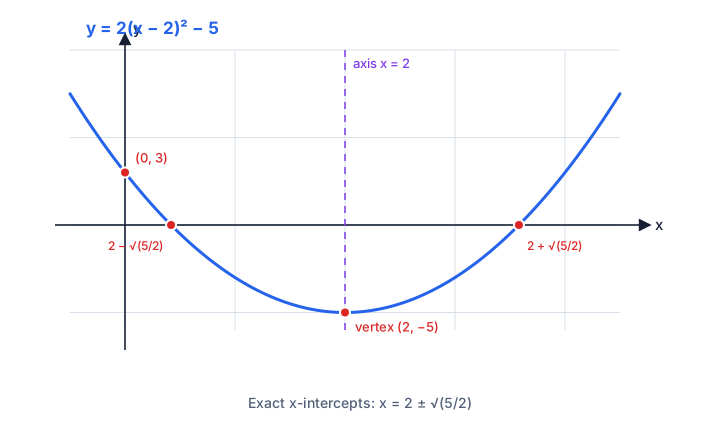
Completing the square is usually the fastest method when a question asks for a maximum or minimum. The squared term is always non-negative, so the extremum follows immediately once the coefficient outside the square is considered.
Solving quadratic equations
To solve , first put every term on one side. Then choose the most efficient method.
Factorisation: use this when the factors are easy to identify.
so the solutions are and .
Completing the square: useful when the vertex or an exact rearrangement is also needed.
The quadratic formula: for ,
The is essential: it represents the two possible square roots when solving an equation.
The discriminant
The quantity
is the discriminant. It determines the number of real roots:
- : two distinct real roots;
- : one repeated real root;
- : no real roots.
These cases also describe how the graph meets the -axis.
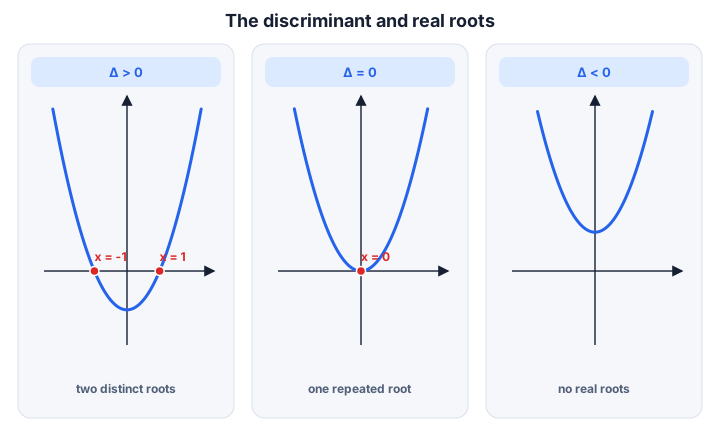
For parameter questions, form the relevant quadratic and apply the appropriate discriminant condition. Words such as two intersections, tangent and no real solution translate respectively to , and .
Sketching a quadratic efficiently
A reliable sketch uses four pieces of information:
- the sign of , which gives the opening direction;
- the -intercept ;
- the real roots, if any;
- the vertex and axis of symmetry.
The roots are symmetric about . A sketch need not be to scale, but all labelled features and their relative positions must be consistent.
Common traps
- Do not use the coefficients until the equation has been rearranged into .
- In the quadratic formula, the denominator is under the whole numerator.
- A repeated root counts as one distinct solution but occurs twice as a factor.
- The discriminant describes real roots, not whether the quadratic has a maximum or minimum; that is determined by the sign of .
- If only the number of roots or intersections is required, a discriminant calculation can be much faster than finding the roots themselves.
Simultaneous equations
Simultaneous equations
Simultaneous equations ask for values that satisfy every given equation at the same time. Graphically, each solution is an intersection point, so a solution must be reported as a complete ordered pair when two variables are involved.
Two linear equations
Linear simultaneous equations can be solved by substitution or elimination.
- Substitution: make one variable the subject of one equation and replace that variable in the other equation.
- Elimination: scale the equations so that adding or subtracting them removes one variable.
For example,
From the first equation, . Substitution gives
so and then . The solution is .
Two distinct non-parallel lines have one solution. Distinct parallel lines have no solution. If one equation is a multiple of the other, both equations describe the same line and there are infinitely many solutions.
One linear and one quadratic equation
The standard analytical method is substitution. Use the linear equation to express one variable in terms of the other, substitute into the quadratic equation, and solve the resulting quadratic. Finally substitute every resulting value back into the linear equation.
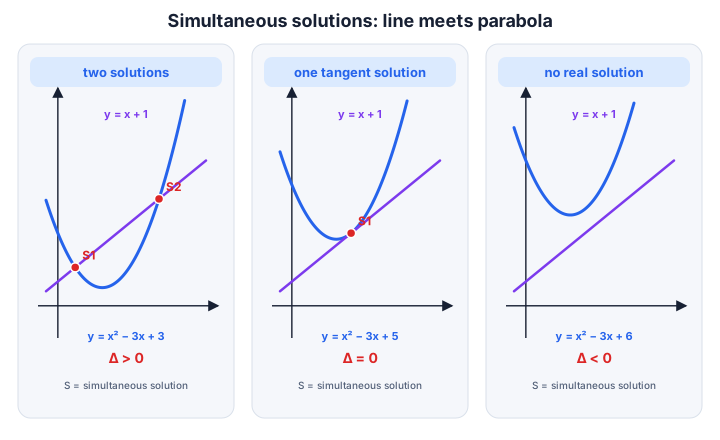
Consider
Equating the two expressions for gives
so
Hence
Using , the two solutions are
The discriminant of the quadratic produced after substitution reveals the geometry:
- positive discriminant: the line meets the parabola twice;
- zero discriminant: the line is tangent to the parabola;
- negative discriminant: there is no real intersection.
Efficient TMUA checks and common traps
- Substitute using the equation that already has a variable isolated, or can be rearranged with the least work.
- Keep exact values until the end. Premature rounding can make a correct pair fail when substituted back.
- Finding is only half the solution; calculate the corresponding for every value of .
- Check each ordered pair in both original equations, especially after squaring or rearranging.
- Do not divide both equations by an expression involving a variable unless you have separately considered the case in which that expression is zero. Otherwise, a valid solution may be lost.
- If only the number of intersections is requested, form the single quadratic and inspect its discriminant instead of solving it fully.
Linear and Quadratic inequalities
Linear and Quadratic inequalities
An inequality describes a set of values rather than usually a single value. The symbols and exclude an endpoint, while and include it.
Linear inequalities
Linear inequalities are rearranged much like linear equations, with one crucial exception: multiplying or dividing by a negative number reverses the inequality sign.
For example,
gives
and division by gives
When the sign of a quantity is unknown, do not divide by it without splitting into cases. This is a frequent source of incorrect solutions.
A double inequality can be manipulated as a chain only when the same valid operation is applied throughout. For example,
leads to
and hence
Quadratic inequalities
To solve a quadratic inequality:
- move every term to one side;
- find the real roots, usually by factorising;
- determine the sign of the quadratic in the intervals separated by those roots;
- include or exclude each root according to the original inequality.
For example,
factorises as
The roots are and . Since the leading coefficient is positive, the parabola lies below the -axis between its roots. Therefore
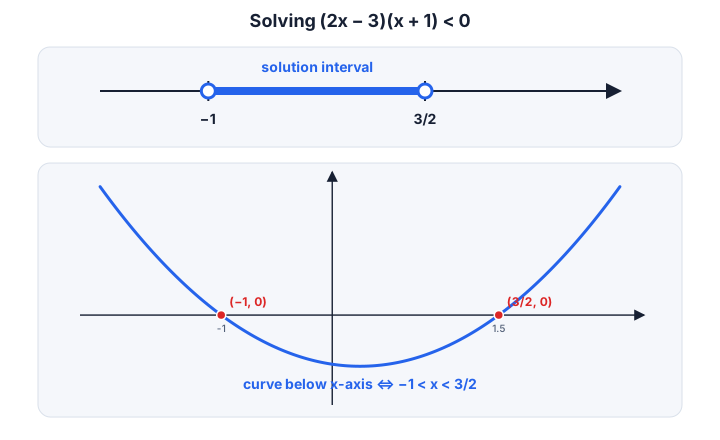
A sign table gives the same conclusion without relying on a polished sketch. Test one value in each interval, or reason from the signs of the factors.
Completed-square form can be more efficient when the inequality compares a square with a constant. For example,
means that is at least units from , so
Root patterns worth recognising
- If a quadratic with has two distinct roots, it is negative between the roots and positive outside them.
- If , these signs are reversed.
- At a repeated root, the graph touches the axis and does not change sign.
- If there are no real roots, a quadratic has the same sign for every real : positive when , negative when .
Common traps
- Do not give only the boundary roots; the solution is an interval or union of intervals.
- Use and for one connected interval, such as , and or for separate regions, such as or .
- A strict inequality uses open endpoints; a non-strict inequality includes roots at which the expression equals zero.
- Do not infer the sign of a product merely from one factor. Either use a sign table or determine the sign on each interval.
- Never cancel a variable factor from an inequality unless its sign and the possibility that it equals zero have both been handled.
Factor and remainder theorem
Factor and remainder theorem
A polynomial is a finite sum of terms of the form , where is a non-negative integer. Its degree is the greatest power with a non-zero coefficient. Secure manipulation of polynomials is needed before the factor and remainder theorems can be used effectively.
Expanding, collecting and factorising
When expanding brackets, multiply every term by every required term, then collect terms with the same power of . Missing powers should be retained as zero-coefficient terms when they help preserve alignment.
Useful factorisations include
Always look first for a common factor. For quadratics, seek two binomial factors or use the quadratic formula to identify roots. Higher-degree polynomials can often be reduced after one linear factor has been found.
Polynomial division
If a polynomial is divided by a non-zero polynomial , then
where is the quotient and the degree of the remainder is less than the degree of .
Polynomial long division repeats the following process:
- divide the leading term of the current expression by the leading term of the divisor;
- place the result in the quotient;
- multiply the whole divisor by that term;
- subtract and repeat.
For example, dividing by gives quotient and remainder . The result can be checked through the identity
When a power is absent, write it with coefficient zero before dividing. This prevents terms in different columns from being combined accidentally.
Division by a quadratic is performed by the same method. For example, divide
by . The first quotient term is . Subtracting leaves
The next quotient term is . Subtracting leaves , whose degree is lower than that of the divisor. Therefore
Thus the quotient is and the remainder is . In general, division by a quadratic produces a remainder of the form , or a lower-degree special case.
The remainder theorem
When is divided by , the remainder is . This follows from
Substituting makes the product term zero, leaving .
For example, if
then the remainder on division by is
For a divisor , substitute its root . Thus the remainder is
Do not substitute , , or the constant term by inspection; first solve the divisor equal to zero.
If the divisor is quadratic, the remainder is generally linear. For a divisor with , write
Substitution of and gives two linear equations,
which determine the remainder without full polynomial division.
The factor theorem
The factor theorem is the zero-remainder case:
It works in both directions. A known root gives a factor, and a known factor gives a root.
To factorise
test sensible integer factors of the constant term. Since
the factor theorem shows that is a factor. Dividing gives
For a monic polynomial with integer coefficients, any integer root must divide the constant term. This gives a short candidate list; it does not mean that every divisor is a root.
Efficient TMUA checks and common traps
- The sign in the theorem is easy to reverse: the factor corresponds to the substitution , while corresponds to .
- Use direct substitution when only a remainder is requested; long division is unnecessary.
- After finding one factor of a cubic, divide to obtain a quadratic and factorise that. Repeatedly testing values is usually slower and can hide a repeated factor.
- The remainder must have lower degree than the divisor. A linear divisor gives a constant remainder; a quadratic divisor gives at most a linear remainder.
- Verify a division by expanding . This catches sign and missing-term errors quickly.
Abstract functions
Abstract functions
A function is a rule that assigns exactly one output to every permitted input. Different inputs may share an output, but a single input cannot produce two different outputs.
The notation means the value produced by the function when the input is . It does not mean . For example, if
then
The permitted inputs matter. The rule cannot accept , while accepts only when working with real numbers.
One-to-one and many-to-one functions
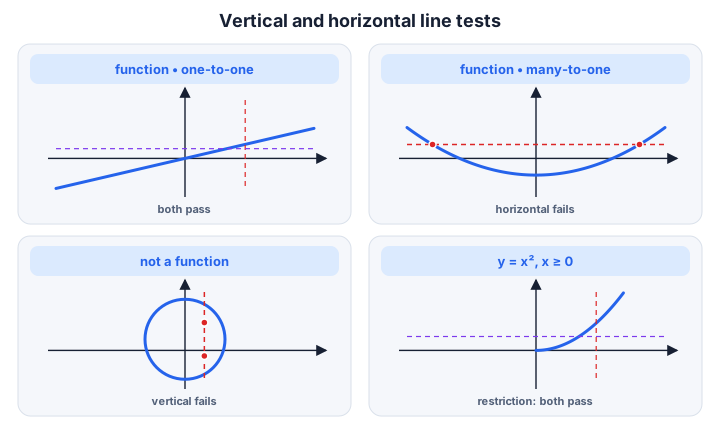
A function is one-to-one if different inputs always produce different outputs. It is many-to-one if at least two different inputs produce the same output.
For example, is one-to-one on the real numbers. The function is many-to-one because, for instance, .
A graph represents a function if every vertical line crosses it at most once. Once it is known to be a function, it is one-to-one if every horizontal line also crosses it at most once.
The square-root function
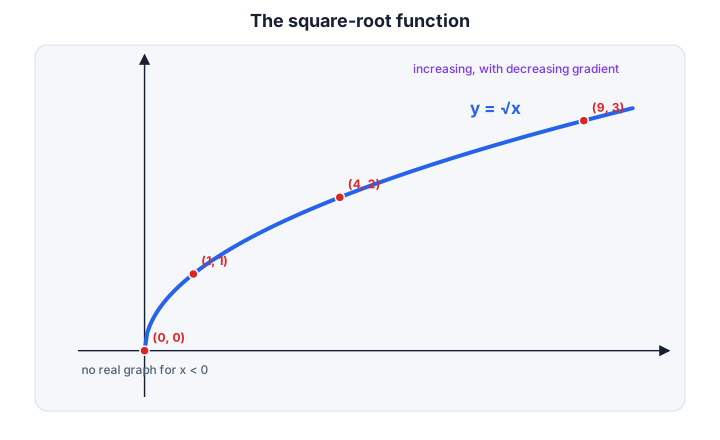
The function
uses the principal, non-negative square root. Its permitted real inputs satisfy , and its outputs satisfy . It is one-to-one and increases as increases.
The distinction between a square root and the solutions of a squared equation is essential:
When an equation has been squared to remove a square root, substitute every proposed solution back into the original equation. Squaring can introduce values that satisfy the squared equation but not the original one.
The modulus function
The modulus is the distance of from zero, so it is never negative:
The graph of is V-shaped. It is many-to-one on the real numbers because .
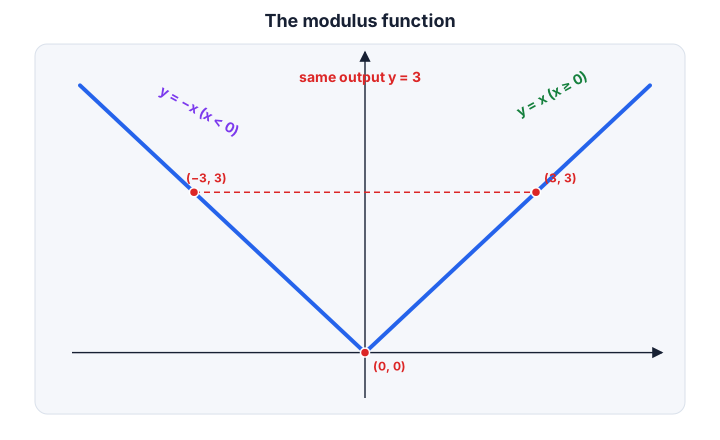
More generally, is the distance between and . Thus
means that is units from , giving or .
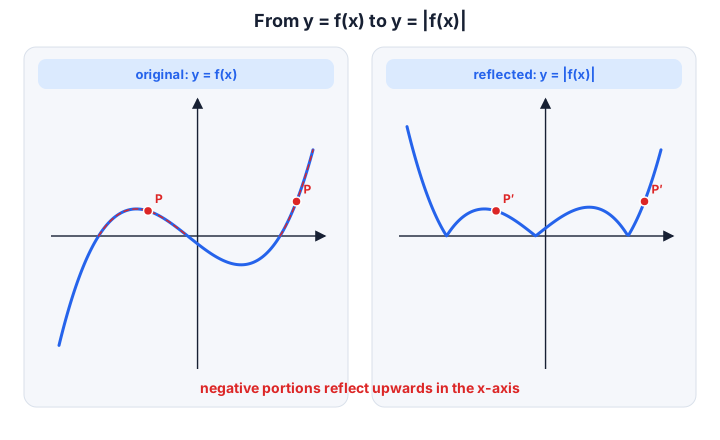
For any function , the graph of is obtained by leaving the parts of on or above the -axis unchanged and reflecting the parts below the axis upwards.
Common traps
- A function may be many-to-one and still be a valid function. The forbidden situation is one input having more than one output.
- The expression does not define as a function of , because most positive inputs produce two outputs.
- Never replace by without qualification; the correct identity is .
- In a modulus equation, split according to the sign of the expression inside the modulus or use a distance interpretation. Check that each result belongs to the case from which it came.
- Pay attention to stated restrictions on the input. They can change a function from many-to-one to one-to-one.