Equation of a Straight Line
Equation of a Straight Line
A straight line is determined by a constant rate of change. On coordinate axes, this rate is the gradient.
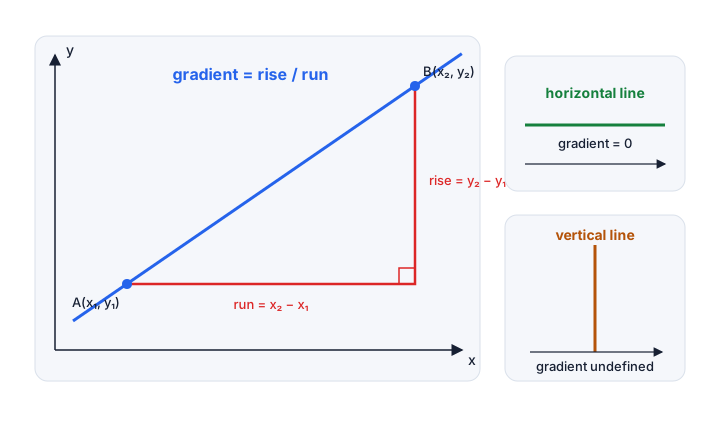
For two distinct points and with , the gradient is
The subtraction order must be consistent: if the numerator is , the denominator must be . A positive gradient means the line rises from left to right; a negative gradient means it falls. A horizontal line has gradient . A vertical line has undefined gradient and must be handled separately.
The familiar form
shows the gradient and the -intercept directly. It is useful, but it cannot represent a vertical line.
Point-gradient form
Suppose a line has gradient and passes through . For any other point on the line, the gradient between the two points must still be :
Rearranging gives
This is normally the fastest form when one point and the gradient are known. There is no need to calculate the intercept unless the problem requires it.
General form
Every straight line can be written as
where and are not both zero.
If , rearranging gives
so the gradient is . If , the equation is vertical. If , it is horizontal.
Multiplying every coefficient by the same non-zero constant does not create a new line. For example,
and
describe the same line.
A common trap is to confuse the in with the in . In the general form, is not automatically the -intercept.
Parallel and perpendicular lines
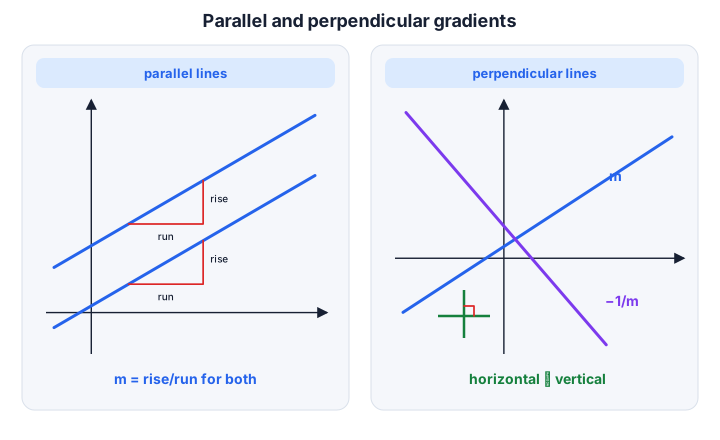
Two non-vertical lines are parallel precisely when their gradients are equal:
They are perpendicular precisely when
Thus a line of gradient has perpendicular gradient . A vertical line and a horizontal line are perpendicular, even though the vertical line has no gradient.
For lines
and
the coefficient conditions are often quicker:
means the lines are parallel or coincident, while
means they are perpendicular.
If all three coefficients are proportional, the equations represent the same line rather than two distinct parallel lines.
Finding the equation from given information
A line is uniquely determined by either:
- one point and its gradient; or
- two distinct points.
When one point and the gradient are known, substitute directly into point-gradient form.
When two points are known:
- calculate the gradient;
- substitute either point into point-gradient form;
- rearrange only if another form is useful.
Special cases must be recognised before dividing:
- if the two points have the same -coordinate, the line is vertical;
- if they have the same -coordinate, the line is horizontal.
Worked example: a line through two points
The line through and has gradient
Using ,
Hence
or equivalently,
Worked example: a perpendicular line
Consider the line
Its gradient is . A perpendicular line therefore has gradient . The perpendicular line through is
which rearranges to
Intersections
The intersection of two lines is the coordinate pair satisfying both equations, so solve the equations simultaneously. Before doing extensive algebra, make a quick sketch: intercepts, symmetry or similar triangles may reveal a shorter route.
TMUA efficiency and common traps
- Use point-gradient form immediately when a point and gradient are given.
- Treat vertical and horizontal lines as special cases rather than forcing them into .
- Keep coordinate subtraction in the same order when finding a gradient.
- For a perpendicular gradient, change the sign and take the reciprocal.
- Sketch before calculating every intersection. A ratio or area may be obtainable from similar triangles without finding all coordinates.
- Substitute a known point into the final equation as a quick check.
Coordinate Geometry of the Circle
Coordinate Geometry of the Circle
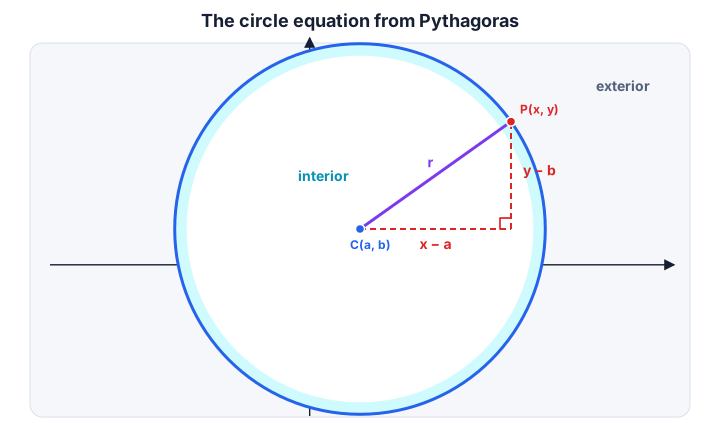
A circle is the set of all points at a fixed distance from a centre. If the centre is and the radius is , a point lies on the circle exactly when its distance from the centre is .
By Pythagoras’ theorem,
This is the centre-radius form of a circle.
The signs inside the brackets are opposite to the coordinates of the centre. For example,
has centre and radius , not centre and not radius .
For a circle centred at the origin, the equation becomes
The corresponding inequalities have a geometric meaning:
describes the interior, while
describes the exterior.
Expanded form and completing the square
The specification also uses
Complete the square separately in and :
Therefore,
So the centre is
and
This final value must be interpreted carefully:
- if , there is a real circle;
- if , the equation represents a single point;
- if , there are no real points satisfying the equation.
Worked example: identifying a circle
Rewrite
Completing the square gives
so
The centre is and the radius is .
A useful recognition check is that, after any overall scaling, a circle equation has equal coefficients of and and no term.
Forming a circle equation
If the centre and radius are known, substitute them directly into centre-radius form.
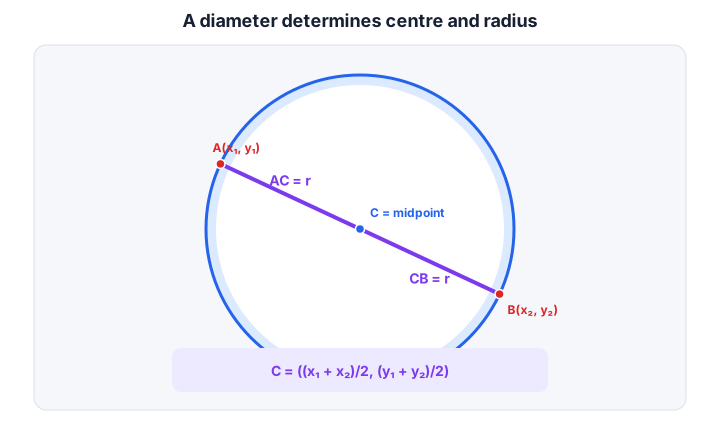
If the endpoints of a diameter are known, first find the midpoint for the centre. If the diameter endpoints are and , then
and the radius is half the distance :
Worked example: a circle from a diameter
A diameter has endpoints and . Its midpoint is
The diameter length is
so the radius is . The equation is
If an equation contains unknown coefficients and several points on the circle are given, substitute each point into
to obtain simultaneous linear equations for , and .
Intersections of a line and a circle
A point where a line meets a circle must satisfy both equations. Substitute the linear equation into the circle equation. The result is a quadratic:
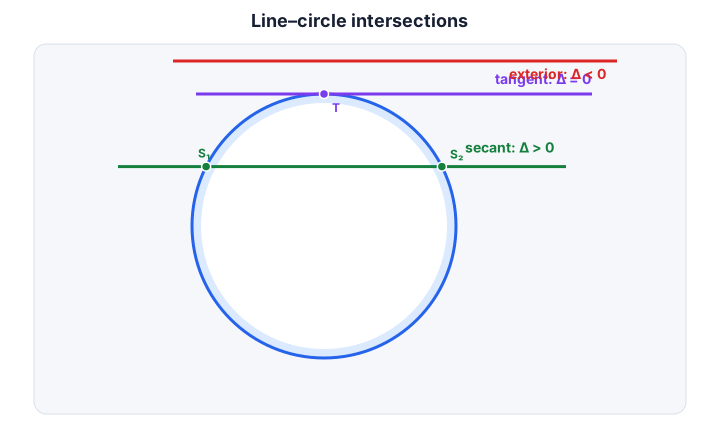
- positive discriminant: two intersection points, so the line is a secant;
- zero discriminant: one repeated intersection point, so the line is tangent;
- negative discriminant: no real intersection.
For example, the line and the circle
give
so . The intersections are and .
By contrast, gives
so is repeated: the line touches the circle at .
TMUA efficiency and common traps
- Complete the square early to expose the centre and radius.
- Read the centre using the opposite signs inside the brackets.
- The radius is the square root of the right-hand side.
- Keep exact values such as rather than using decimals.
- When a line and circle are involved, decide whether geometry or substitution is shorter.
- A repeated quadratic root signals tangency.
- Check that the proposed point satisfies both equations.
Circle Properties
Circle Properties
Circle properties connect angles, chords, radii and tangents. In TMUA problems, the quickest route is often to add one helpful line, mark equal radii and then angle-chase.
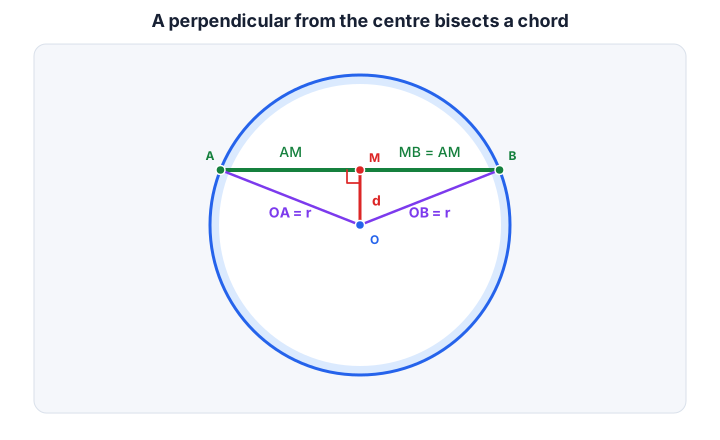
1. A perpendicular from the centre to a chord bisects the chord
Let be a chord of a circle with centre , and let be perpendicular to . The right-angled triangles and have equal hypotenuses because , and they share the side . They are congruent, so
The converse is also useful: the line from the centre to the midpoint of a chord is perpendicular to the chord.
If the radius is and the perpendicular distance from the centre to the chord is , then Pythagoras gives
so the chord length is
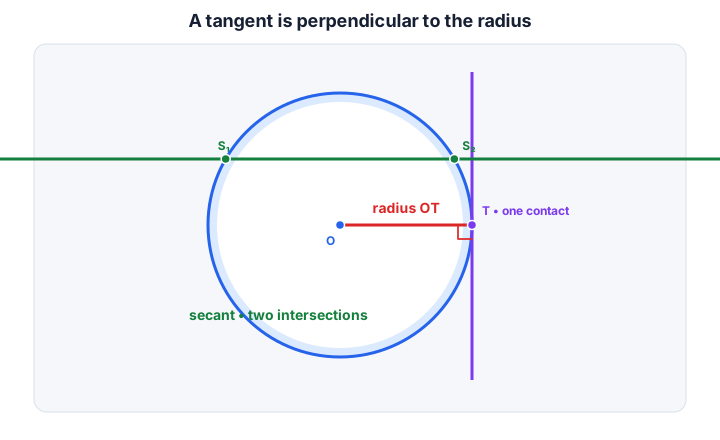
2. A tangent is perpendicular to the radius at the point of contact
Let a tangent touch the circle at . The radius is perpendicular to the tangent.
One way to understand this is to suppose the perpendicular from to the tangent met it at a different point . Then , so would lie inside the circle. A line passing through an interior point must cut the circle twice, contradicting the fact that the line is tangent. Hence the perpendicular meets the tangent at .
This property turns tangent problems into straight-line problems: find the gradient of the radius, then use the perpendicular gradient for the tangent.
Worked example: equation of a tangent
The circle
has centre . The point lies on the circle. The gradient of is
Therefore, the tangent at has gradient :
Hence its equation is
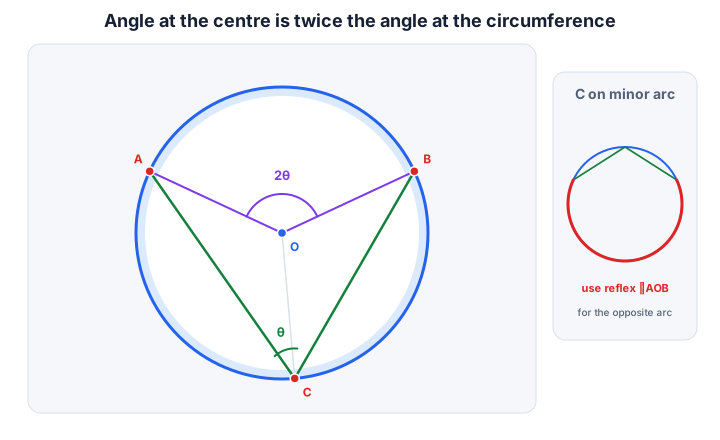
3. The angle at the centre is twice the angle at the circumference
Let and be endpoints of an arc and let be a point on the remaining circumference. Then the angle subtended by the same arc at the centre is twice the angle subtended at the circumference:
The result follows by joining to , and . The radii create isosceles triangles, so their base angles can be expressed in terms of the angles at . The angles around then produce the factor of .
The phrase same arc matters. If lies on the minor arc , the corresponding angle at the centre is the reflex angle , not the smaller one.
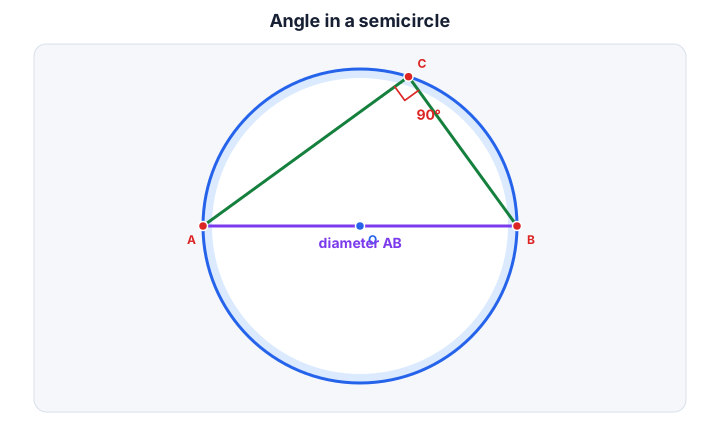
4. The angle in a semicircle is a right angle
If is a diameter and is any other point on the circle, then
The diameter subtends an angle of at the centre, so the angle at the circumference is half of this.
The converse is useful: if , then is a diameter of the circumcircle of triangle .
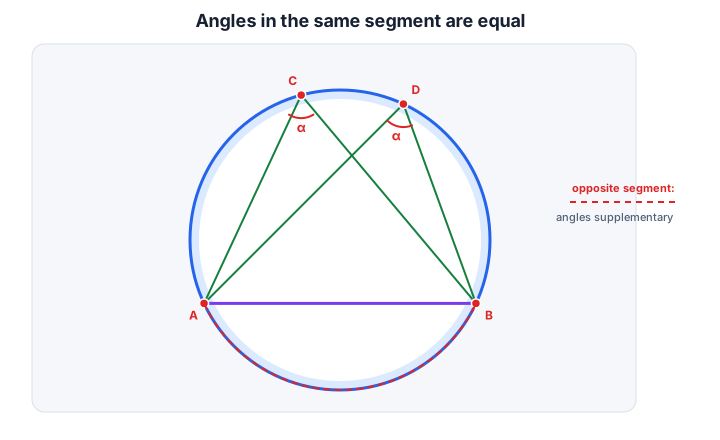
5. Angles in the same segment are equal
If points and lie in the same segment determined by chord , then
Both angles stand on the same chord and are each half the same angle at the centre.
A common mistake is to compare points on opposite sides of the chord. In that case the two angles are supplementary rather than equal.
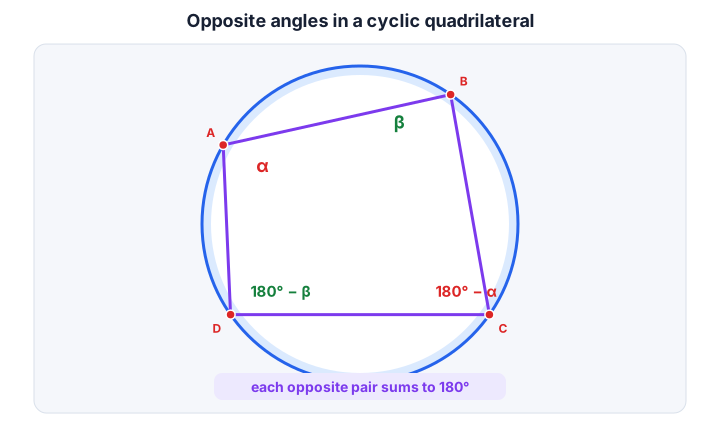
6. Opposite angles in a cyclic quadrilateral sum to
A cyclic quadrilateral has all four vertices on one circle. If , , and occur in order around the circle, then
and
Each opposite angle is half the central angle standing on its corresponding arc, and the two arcs together make .
The converse is frequently useful: if a pair of opposite angles in a quadrilateral sums to , the quadrilateral is cyclic.
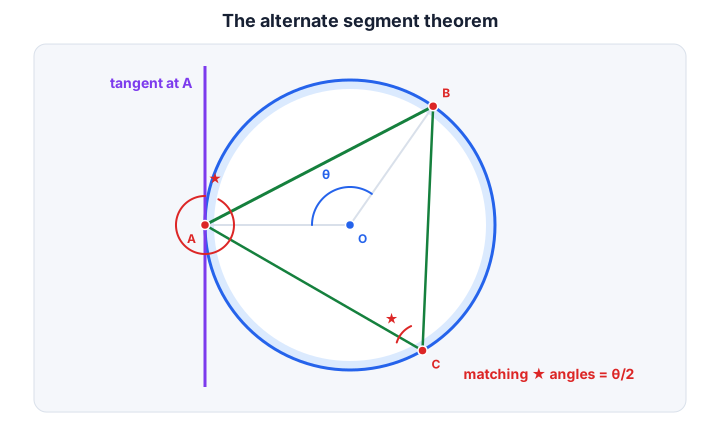
7. The alternate segment theorem
The angle between a tangent and a chord at the point of contact equals the angle subtended by that chord in the opposite segment.
Suppose a tangent touches the circle at , and is a chord. For a point on the opposite arc,
To see why, let . Triangle is isosceles, so
The tangent is perpendicular to , so the tangent-chord angle is
But by the angle-at-the-centre theorem.
Choose the tangent-chord angle on the side opposite . Using the wrong adjacent angle gives its supplement.
Worked example: combining properties
Let be a diameter and let lie on the circle with
Because the angle in a semicircle is a right angle,
The angles in triangle therefore give
A tangent at makes an angle of with chord , by the alternate segment theorem.
Efficient circle-theorem strategy
- Mark every radius as equal; this often creates isosceles triangles.
- Add a radius to a point of tangency.
- Add a diameter when a right angle would help.
- Identify the chord or arc on which each angle stands.
- Use the converse of the semicircle and cyclic-quadrilateral results when you need to prove points are concyclic.
- Do not trust the apparent size of an angle in a diagram.
- Angle-chase only after marking all immediate equal angles, right angles and supplementary pairs.