Sine Rule, Cosine Rule and Triangle Area
Sine Rule, Cosine Rule and Triangle Area
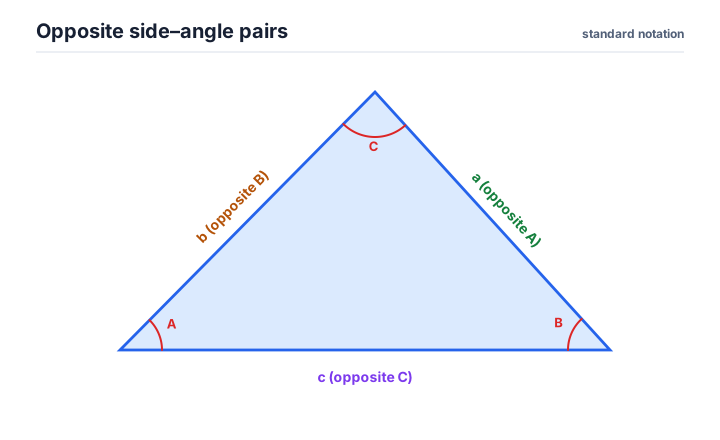
For a triangle , use the standard convention that side is opposite angle , side is opposite angle , and side is opposite angle . Matching each angle with its opposite side is essential when using the sine and cosine rules.
Area using two sides and the included angle
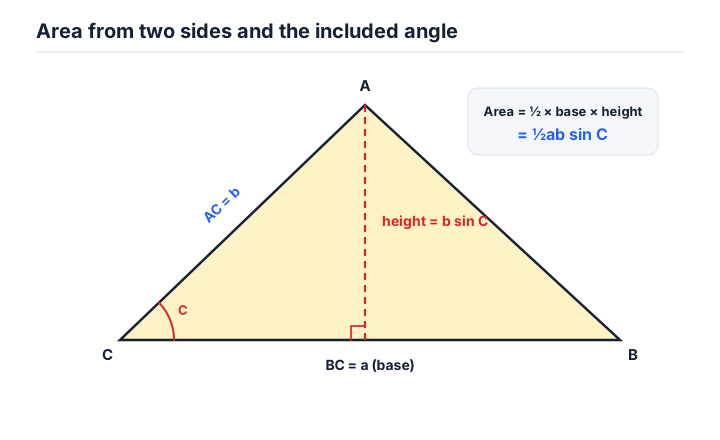
The usual area formula is
Suppose sides and enclose angle . The component of side perpendicular to side is , so
Therefore,
and, by relabelling,
The angle in the formula must be the angle between the two stated sides.
Worked example
Two sides of a triangle have lengths and , and the angle between them is . Its area is
A common mistake is to use an angle that is not between the two given sides.
The sine rule
The three expressions for the area of a triangle are equal:
Dividing by gives
Equivalently,
Use the sine rule when a known side and its opposite angle form a complete pair.
Typical situations are:
- two angles and one side, to find another side;
- two sides and an angle opposite one of them, to find another angle.
Place corresponding sides and angles in the same position in each fraction. For example,
not .
Worked example
In a triangle, , , and . To find ,
Therefore,
The ambiguous case
The ambiguous case occurs when two sides and a non-included angle are known. This is often called the angle–side–side or SSA case.
Suppose , , and are known. The sine rule gives
If this value is between and , there may be two possible angles:
and
This happens because
Each candidate must be checked against
A candidate that makes the angle sum at least does not produce a triangle.
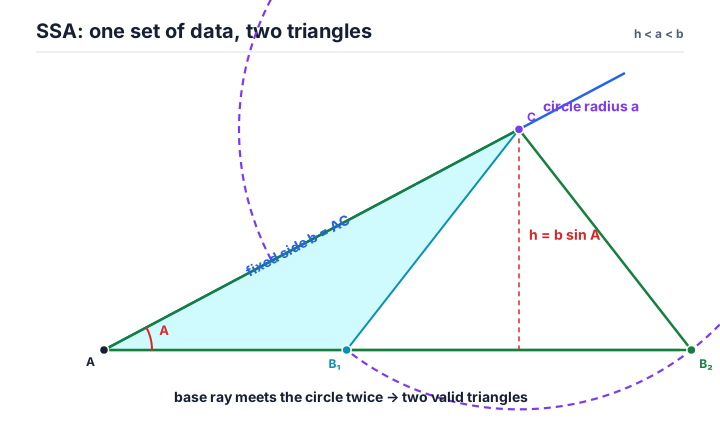
For an acute known angle , define the perpendicular height
The possibilities are:
| Condition | Number of triangles |
|---|---|
| , a right-angled triangle | |
If the known angle is obtuse, its opposite side must be the longest side. Therefore:
- gives one triangle;
- gives no triangle.
The safest exam method is to find both possible sine solutions and test the angle sum rather than relying only on memorised cases.
Worked example
Suppose
The sine rule gives
Therefore,
Both are possible because
and
The two possible third angles are therefore
The cosine rule
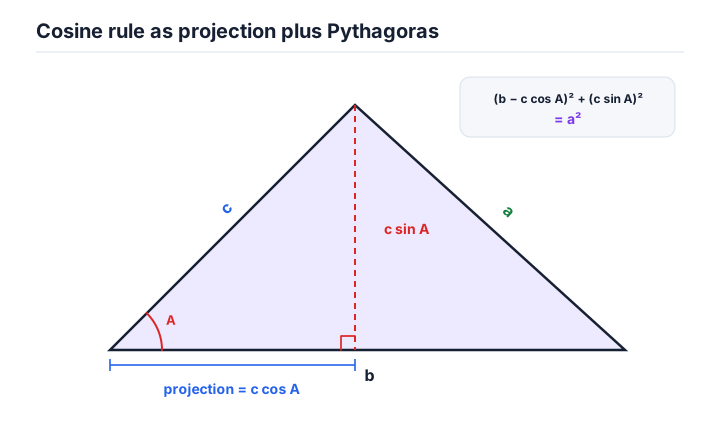
For any triangle,
The side isolated on the left is opposite the angle used in the cosine term. The other forms are
and
The cosine rule can be viewed as Pythagoras’ theorem with a correction term. If , then , so
Use the cosine rule when:
- two sides and their included angle are known, to find the third side;
- all three sides are known, to find an angle.
To find an angle, rearrange:
Worked example
Two sides have lengths and , and the included angle is . If the opposite side is , then
Hence
so
The cosine rule also provides a useful check:
The longest side must be opposite the largest angle.
Choosing an efficient method
Before calculating, identify the information pattern:
| Information given | Efficient method |
|---|---|
| Two sides and their included angle | Cosine rule for the third side |
| Three sides | Cosine rule for an angle |
| A side–opposite-angle pair and another side or angle | Sine rule |
| Two sides and their included angle, with area required | |
| Right-angled triangle | Pythagoras and basic right-angle trigonometry are usually faster |
The triangle inequality can sometimes avoid unnecessary trigonometry. Three positive lengths form a non-degenerate triangle only when the sum of every pair exceeds the third side. It is enough to check that the two shorter sides add to more than the longest side.
Problems in three dimensions
A three-dimensional problem should usually be reduced to one or more ordinary two-dimensional triangles.
A reliable method is:
- Mark the required angle or length clearly.
- Find useful face diagonals using Pythagoras’ theorem.
- Identify a plane containing the required points.
- Work only within the resulting triangle.
- Apply the sine rule, cosine rule, area formula or right-angle trigonometry as appropriate.
Do not use an angle from a flat projection unless it is genuinely the required spatial angle.
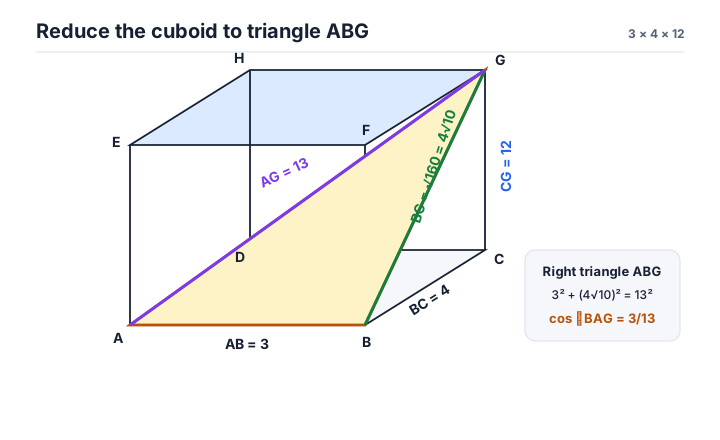
For example, in the cuboid shown,
and
In triangle , the cosine rule gives
Therefore,
Common traps include pairing the wrong side with an angle, using a non-included angle in the area formula, overlooking the second SSA triangle, and rounding intermediate values unnecessarily.
Radian Measure, Arc Length, Sectors and Segments
Radian Measure, Arc Length, Sectors and Segments
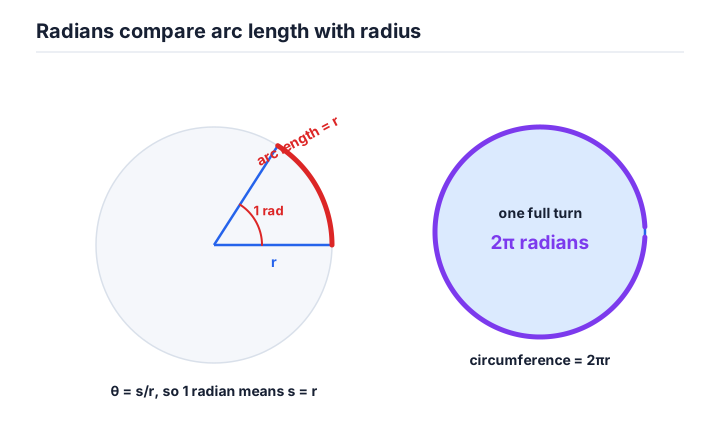
Degrees divide one complete revolution into equal parts. Radians instead measure an angle by comparing an arc length with the radius of its circle.
An angle of radian subtends an arc whose length equals the radius.
More generally,
when is measured in radians.
Since the circumference of a circle is , one complete revolution is
Therefore,
Converting between degrees and radians
To convert degrees to radians, multiply by :
To convert radians to degrees, multiply by :
Important conversions are:
| Degrees | Radians |
|---|---|
An angle written without a degree symbol is normally interpreted as being in radians.
Arc length
For a central angle radians in a circle of radius ,
This follows immediately from the definition
The formula requires to be in radians.
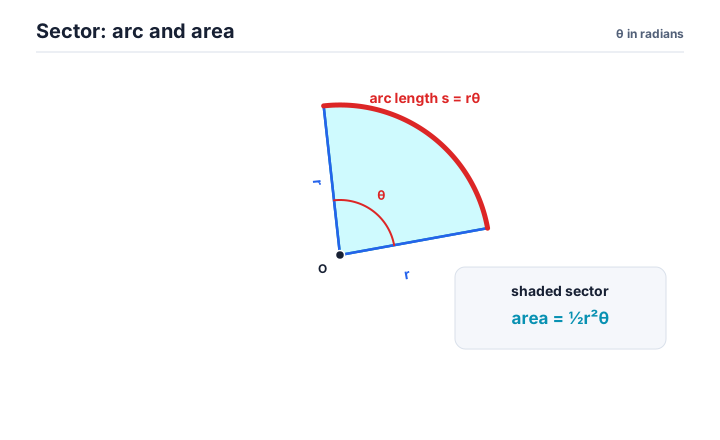
Area of a sector
A sector with angle is the fraction of a full circle. Therefore,
so
Area of a segment
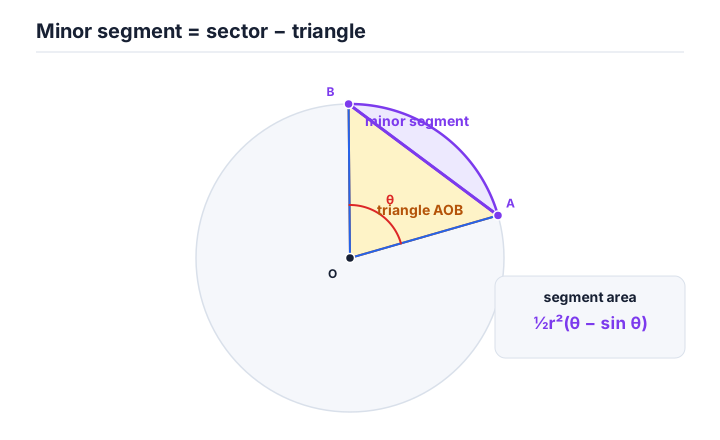
A segment is the region between a chord and its corresponding arc. For a minor segment with ,
The two radii form a triangle with sides and and included angle , so
Therefore,
The angle must be in radians in the sector term.
The major segment can be found by subtracting the minor segment from the full circle:
The chord bounding the segment has length
This follows by bisecting the isosceles triangle formed by the two radii.
Worked example
A circle has radius , and a sector has angle .
Its arc length is
Its sector area is
The triangle inside the sector has area
Therefore, the minor segment area is
Common mistakes include using degrees directly in , forgetting the factor in the sector formula, and giving the sector area when the question asks for a segment.
Exact Values of Sine, Cosine and Tangent
Exact Values of Sine, Cosine and Tangent
The exact trigonometric values for , , , , and must be recalled quickly and without a calculator.
They can be reconstructed from two standard triangles.
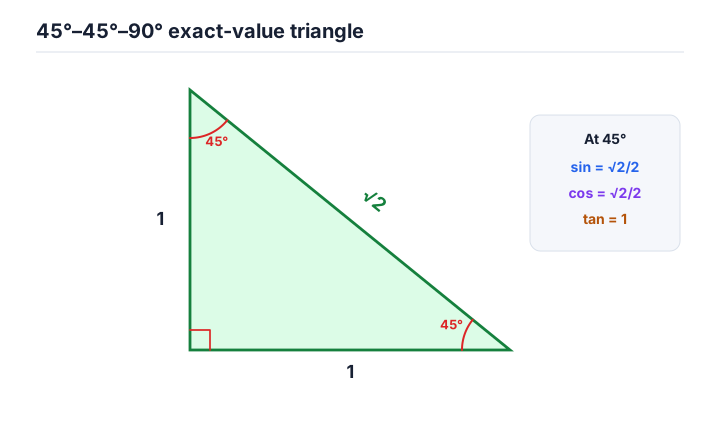
The -- triangle
Take an isosceles right-angled triangle whose shorter sides both have length . Pythagoras’ theorem gives the hypotenuse:
Therefore,
and
The -- triangle
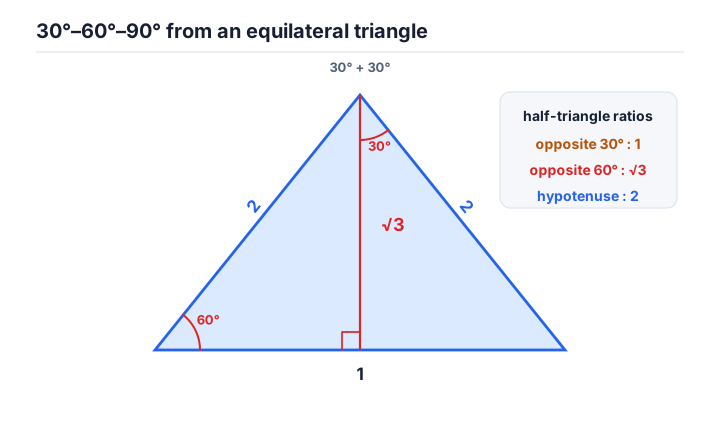
Bisect an equilateral triangle of side length . Each resulting right-angled triangle has:
- hypotenuse ;
- shorter side ;
- remaining side .
This gives
It also gives
Exact-value table
| Angle | |||||
|---|---|---|---|---|---|
| Radians | |||||
| undefined |
A quick memory pattern for sine is
The cosine values are the same list in reverse order. Tangent can then be obtained from
Tangent is undefined at because this would require division by
Values outside the first quadrant can be found from the reference angle and the sign of the function. For example,
and
Keep exact values in surd form. Replacing with a decimal usually makes comparisons and later algebra less efficient.
Trigonometric Functions: Graphs, Symmetries and Periodicity
Trigonometric Functions: Graphs, Symmetries and Periodicity
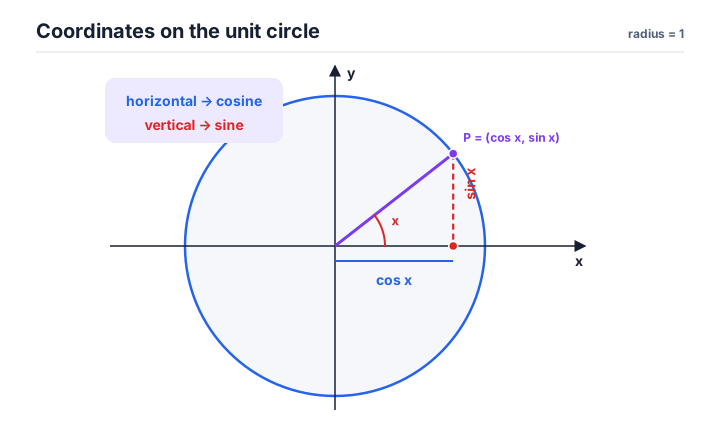
Sine and cosine can be understood using a point moving around a unit circle. If the point is at angle from the positive horizontal axis, its coordinates are
Thus, cosine is the horizontal projection and sine is the vertical projection. Tangent is
so it represents the ratio of the vertical projection to the horizontal projection whenever .
The sine graph
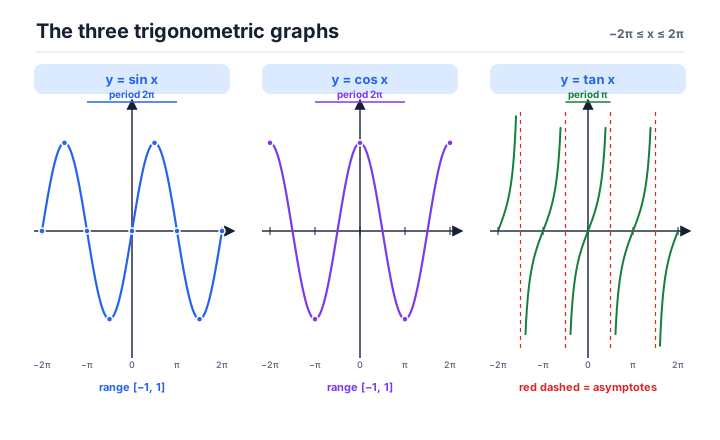
The graph :
- passes through ;
- has maximum value ;
- has minimum value ;
- has period , or ;
- has range .
Its key values over one period are
Its zeros occur at
The cosine graph
The graph :
- begins at ;
- has maximum value ;
- has minimum value ;
- has period , or ;
- has range .
Its key values over one period are
Its zeros occur at
The tangent graph
The graph :
- passes through ;
- has period , or ;
- has range ;
- is undefined where ;
- has vertical asymptotes at
Its zeros occur at
Periodicity
A periodic function repeats after a fixed horizontal interval.
For sine and cosine,
and
For tangent,
More generally,
and
where is any integer.
Symmetry
Sine is an odd function:
Its graph has rotational symmetry of about the origin.
Cosine is an even function:
Its graph has reflection symmetry in the -axis.
Tangent is an odd function:
Its graph has rotational symmetry of about the origin.
Other useful symmetry relationships include
and
In degrees, replace by .
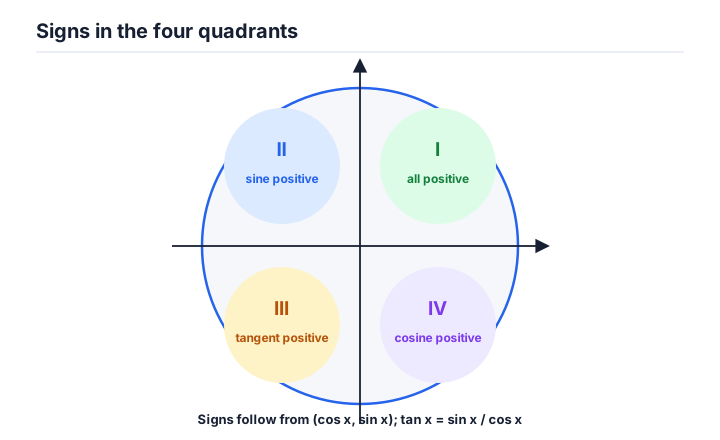
Signs in the four quadrants
The signs follow from the coordinates :
| Quadrant | Positive functions |
|---|---|
| I | sine, cosine and tangent |
| II | sine only |
| III | tangent only |
| IV | cosine only |
Transformations and periods
For
or
the amplitude is
the period in radians is
and the central horizontal line is
The horizontal translation is
It is often safest to factor the expression inside the function:
Therefore, the horizontal shift is to the left, not .
For
the period is
Tangent has no amplitude because it is unbounded.
In degrees, the corresponding periods are
for sine and cosine, and
for tangent.
Graphs can often answer comparison or solution-count questions faster than lengthy algebra. For example, on , sine is increasing and cosine is decreasing. This allows exact values to be ordered without calculating unfamiliar expressions.
Fundamental Trigonometric Identities
Fundamental Trigonometric Identities
The two identities required are
and
Here,
means
It does not mean .
Deriving the Pythagorean identity
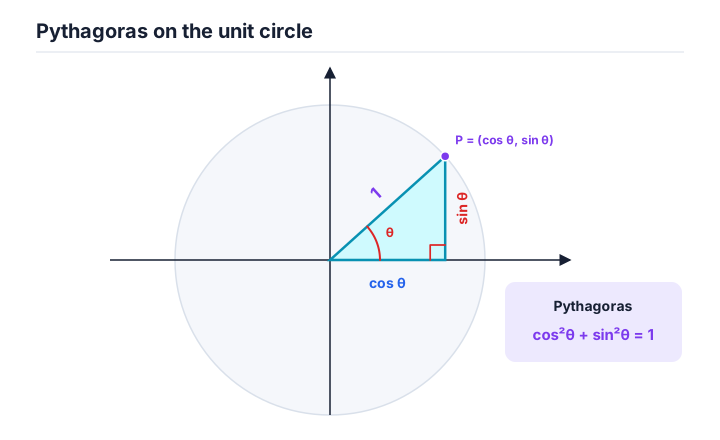
On the unit circle, the point at angle has coordinates
Every point on the unit circle satisfies
Substituting and gives
This is Pythagoras’ theorem expressed using trigonometric coordinates, and it is valid for every real angle.
Useful rearrangements are
and
These allow equations involving both sine and cosine to be converted into equations involving only one function.
Deriving the tangent identity
In a right-angled triangle,
and
Therefore,
The identity is valid only when
because tangent is undefined when the denominator is zero.
Using the identities
For example,
can be simplified using
Thus,
provided that .
The restriction matters: cancelling a factor of silently assumes it is non-zero.
The Pythagorean identity can also be used to compare expressions. For example,
Useful algebraic habits include:
- converting everything to sine when an equation is quadratic in ;
- converting everything to cosine when it is quadratic in ;
- replacing tangent by when this exposes a factorisation;
- avoiding division by a trigonometric expression unless its zero cases have already been considered.
Also remember that
not necessarily . Taking the square root of a squared equation usually introduces both positive and negative cases.
Solving Trigonometric Equations in a Given Interval
Solving Trigonometric Equations in a Given Interval
A trigonometric equation normally has infinitely many solutions because the functions are periodic. An interval restricts the answer to a finite set.
A reliable method is:
- Check whether angles are measured in degrees or radians.
- Rearrange until one trigonometric expression is isolated, or convert the equation into one trigonometric function.
- Find the reference or principal solution.
- Use symmetry and periodicity to generate every solution for the whole inner angle.
- Rearrange to find .
- Keep only values in the stated interval.
- Check excluded endpoints and any values lost through division or square roots.
When the equation contains , it is often efficient to set
Convert the interval for into an interval for , solve for , and only then return to . This prevents solutions from being missed.
Standard solution forms
If
let
Then
where .
If
let
Then
If
let
Then
In degrees, replace by and by .
These formulas are useful, but a correctly labelled graph or quadrant diagram is equally valid and can be faster for exact-value equations.
Worked example: tangent equation
Solve
for
The reference angle is , because
Tangent is negative in quadrants II and IV. Its general solution is
The values in the interval are
Equations involving a square
If
then
Both signs are required. Equivalently, the solutions can be written compactly as
Worked example: transformed squared equation
Solve
for
Let
Since ,
Therefore,
so
Applying the interval gives
This is satisfied by
Hence the complete solution set is
There are solutions.
Equations involving both sine and cosine
Use
to rewrite the equation using only one trigonometric function.
Worked example
Solve
for
Use
Simplifying gives
Factorising,
Therefore,
or
Within the stated open interval,
gives
while
gives
Thus,
Do not divide the equation by , because that would lose the valid solution arising from .
Counting solutions graphically
Some questions require only the number of solutions. Sketching both sides as functions can be faster than finding every value explicitly.
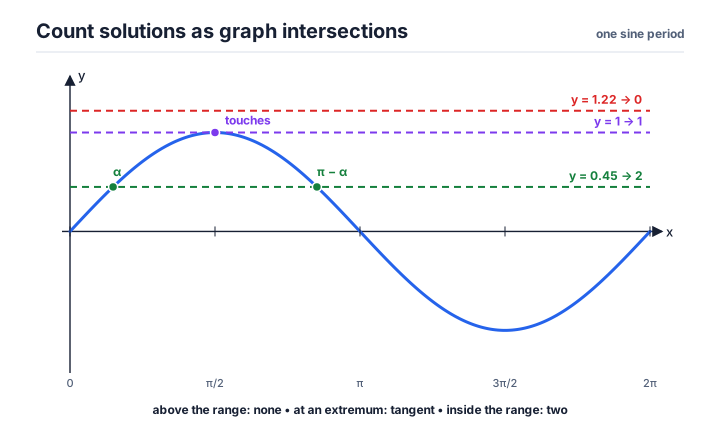
For an equation
the number of solutions is the number of intersections of the graphs
within the interval.
Use the period to estimate how many repeating sections occur, but inspect the endpoints and turning points carefully. A horizontal line may:
- miss a sine or cosine graph;
- touch it once at a maximum or minimum;
- cross it twice in one period.
Since
and
equations such as
or
have no real solutions.
Tangent can take every real value, although its asymptotes divide the graph into separate branches.
The most frequent errors are:
- mixing degrees and radians;
- finding only the principal solution;
- forgetting the second sine or cosine solution;
- forgetting the negative square root after removing a square;
- solving for before generating all solutions for the inner angle;
- including an endpoint that the interval excludes;
- dividing by , , or another expression that could be zero;
- accepting an inverse-trigonometric output without checking the correct quadrant;
- rounding exact values too early.
A final substitution or graphical check is often quick and can detect an omitted or extraneous solution.