Exponential Functions and the Graph of
Exponential Functions and the Graph of
An exponential function has the variable in the exponent. For this topic, the basic form is
where is a positive constant. The value of the base determines the shape of the graph.
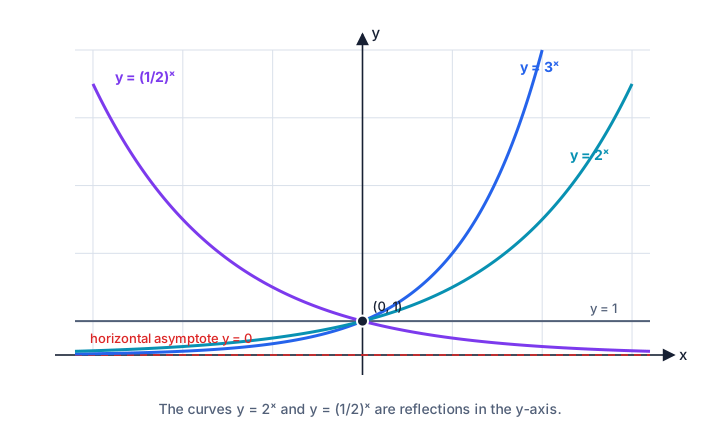
Every graph of passes through because
For every real , the value of is positive. Therefore, the graph never crosses or touches the -axis.
| Value of the base | Behaviour of |
|---|---|
| The function is increasing. As increases, grows; as becomes very negative, approaches . | |
| The function is constant because , so the graph is the horizontal line . | |
| The function is decreasing. As increases, approaches ; as becomes very negative, grows. |
For with , the graph has:
- domain: all real values of ;
- range: ;
- -intercept: ;
- horizontal asymptote: .
The graph never reaches its horizontal asymptote. It only gets arbitrarily close to it.
Reciprocal bases produce reflected graphs because
Therefore, the graph of is the reflection of the graph of in the -axis.
A useful TMUA observation is that graph behaviour can determine the number of solutions without finding them explicitly. For example, if , then is strictly increasing, so an equation can have at most one real solution.
Common mistake: a negative base is not part of this graph family. Expressions such as are not real for every real , so they do not define a continuous real-valued exponential function on the whole real line.
Logarithms as Inverse Exponents
Logarithms as Inverse Exponents
A logarithm answers the question: “To what power must the base be raised to obtain this number?”
The statements
and
mean exactly the same thing.
For example,
and
For real logarithms, the base and argument must satisfy
The base cannot be because is always , so it cannot produce every positive number. The argument must be positive because is positive for every real when .
Two immediate consequences of the definition are
because , and
because .
The inverse relationship also gives
and
TMUA method: when a logarithm looks unfamiliar, return to index form. For example, instead of trying to recall a special rule for , write
Since ,
so and therefore
Laws of Logarithms
Laws of Logarithms
The logarithm laws follow from the laws of indices. Throughout this section, all logarithms have the same valid base , and every logarithm argument is positive.
The product law is
It corresponds to multiplying powers with the same base:
The quotient law is
It corresponds to dividing powers with the same base:
The power law is
It corresponds to raising a power to another power:
A special case of the quotient and power laws is
because
Worked example
Simplify
Use the power law first:
Then combine the logarithms:
The order of operations matters. A coefficient in front of a logarithm becomes a power of its argument; it does not multiply the argument:
not .
Common traps:
and
There is no logarithm law for splitting a sum or difference inside a logarithm. Also, never combine logarithms with different bases using the product, quotient, or power laws.
Questions requiring the change-of-base formula are not part of this specification, so it is not needed for this topic.
Solving Exponential Equations by Rewriting to a Common Base
Solving Exponential Equations by Rewriting to a Common Base
When both sides of an exponential equation can be written with the same base, rewrite them before using logarithms. This is usually the fastest method.
For and ,
This works because is one-to-one: each output is produced by only one input.
Worked example
Solve
Write both sides as powers of :
Therefore,
Equate the exponents:
so
Before taking logarithms, look for bases that are powers of a common number. Common rewrites include
Common mistake: from
but not . Addition does not follow the multiplication law for indices.
Solving Equations of the Form
Solving Equations of the Form
For
where , , and , the exact solution is
This is simply the definition of a logarithm.
If , there is no real solution because is always positive. If , there is exactly one real solution because is strictly increasing when and strictly decreasing when .
Worked example
Solve
Treat the entire exponent as the power required to turn into :
Hence
This is an exact answer. No decimal approximation is required.
Equations may need rearranging before they reach the form .
Worked example
Solve
Since , division by is always valid:
Therefore,
so
TMUA method: keep answers in exact logarithmic form unless the question supplies enough information for an exact simplification. On a non-calculator paper, an awkward logarithm is often intended to remain in the answer.
Equations Reducible to a Quadratic in a Power
Equations Reducible to a Quadratic in a Power
Some exponential equations become ordinary quadratics after a substitution. The key recognition is
More generally, powers such as , , and can be treated as powers of the single quantity .
Worked example
Solve
Since
let
The equation becomes
Factorise:
Therefore,
Return to :
and
Hence the solutions are
The substitution has an important restriction:
Therefore, any zero or negative solution for must be rejected.
For example, if a substitution produces
then is possible but is impossible when .
A reliable method is:
- Rewrite every exponential term using one base.
- Identify a repeated quantity such as .
- Substitute and record .
- Solve the resulting polynomial equation.
- Reject non-positive values of .
- Substitute back and solve each remaining equation of the form .
Common mistake: solving the quadratic in is not the end of the problem. The final answers must be values of the original variable .