Definite Integration and Area Between a Curve and an Axis
Definite Integration and Area Between a Curve and an Axis
Integration can be viewed in two connected ways:
- as reversing differentiation;
- as accumulating signed area between a graph and an axis.
A definite integral has numerical limits:
Geometrically, this gives the signed area between the graph , the -axis, and the vertical lines and .
- A region above the -axis contributes positively.
- A region below the -axis contributes negatively.
Therefore, a definite integral is not always the same as the total geometric area. If the graph crosses the axis, positive and negative contributions may partly or completely cancel.
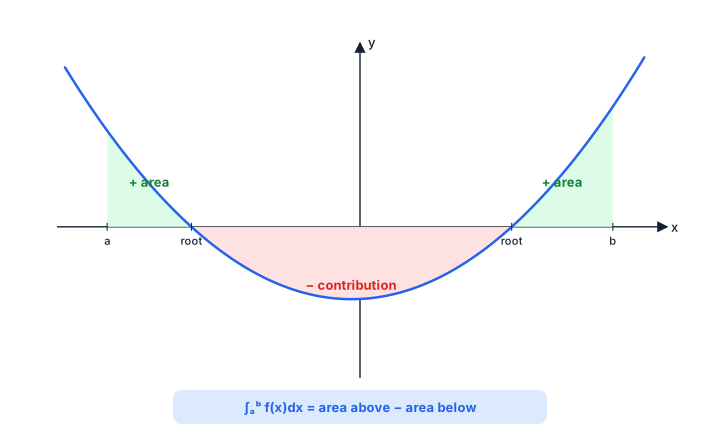
To find the total area between a curve and the -axis, first find every point where the curve crosses the axis. Split the interval at those points, evaluate each definite integral separately, and add the positive magnitudes:
although in TMUA calculations it is usually quicker to split the integral rather than integrate a modulus expression directly.
Worked example
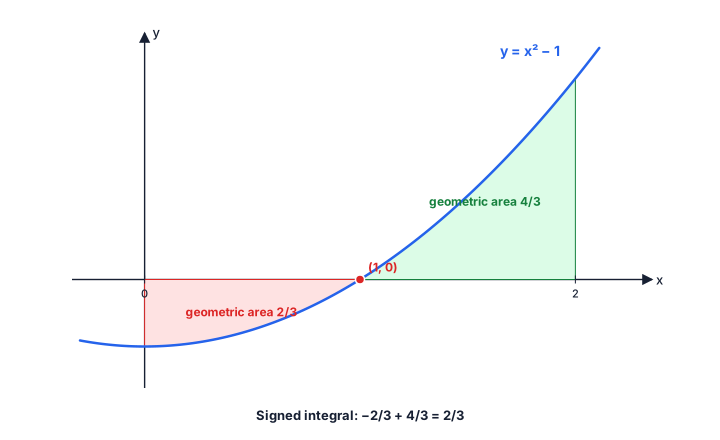
Find both the definite integral and the total area between
and the -axis from to .
The definite integral is
However, the curve crosses the axis at . It is below the axis on and above the axis on .
so the first geometric area is . Also,
Hence
The integral is , but the total area is .
Symmetry can give a definite integral without any algebra. If is even, so that , then
If is odd, so that , then
For an odd function, equal regions on opposite sides of the origin have opposite signs and cancel. This is a useful TMUA shortcut: inspect the graph and the limits before beginning a long calculation.
Common traps
- Do not report a negative value for a geometric area.
- Do not assume that a definite integral gives the total area when the graph crosses the axis.
- A zero integral does not imply that there is no enclosed area; it may mean that positive and negative contributions cancel.
Definite and Indefinite Integrals of Powers of
Definite and Indefinite Integrals of Powers of
An indefinite integral asks for the family of functions whose derivative is the integrand. Since differentiating a constant gives zero, an arbitrary constant must be included:
when .
For any rational exponent ,
where is constant.
The method is:
- add to the exponent;
- divide the coefficient by the new exponent;
- include for an indefinite integral.
The case is excluded from this TMUA rule.
Integration is linear, so sums and differences can be integrated term by term:
For a definite integral, use the same antiderivative but evaluate it at the limits. The constant is unnecessary because it cancels:
Many TMUA expressions must be simplified before the power rule becomes visible. Expand brackets, split fractions and rewrite roots or reciprocals as powers.
Worked example 1
Therefore,
Worked example 2
For ,
Simplify before integrating:
Now apply the power rule term by term:
A quick differentiation of the result is an efficient check.
Common traps and efficient methods
- Rewrite as before integrating.
- Expand or simplify first; advanced methods such as substitution and integration by parts are not required.
- Do not use the differentiation rule by mistake. Integration increases the exponent by .
- Include only for an indefinite integral, not after evaluating fixed limits.
- Never split a quotient as
this is not a valid rule.
The Fundamental Theorem of Calculus
The Fundamental Theorem of Calculus
The Fundamental Theorem of Calculus connects the two interpretations of integration: reversing differentiation and accumulating area.
If
then
This explains the standard method for evaluating a definite integral. Any constant in disappears because
Worked example
Evaluate
An antiderivative is
Hence
The theorem also works in the other direction. Define an accumulation function
As increases slightly, the accumulated signed area changes at a rate equal to the current height of the graph. Therefore,
The letter is a dummy variable. It avoids confusing the variable inside the integral with the variable upper limit.
Worked example
If
then immediately
No integration is needed.
Two useful consequences are
and
Reversing the limits reverses the orientation of the interval, so the sign changes.
TMUA insight: when a question differentiates an integral whose upper limit is , use the theorem before attempting to find an antiderivative. This is often much faster.
Combining Integrals over Equal or Contiguous Ranges
Combining Integrals over Equal or Contiguous Ranges
Integrals can be combined algebraically when their ranges and integrands fit the relevant rules.
For equal limits, integration distributes over addition and subtraction:
More generally,
This is useful when combining information about several integrals without finding the functions explicitly.
For the same integrand on contiguous ranges,
The rule remains valid even when the points are not written in increasing order, provided the function is defined throughout the required intervals. The signs created by reversed limits handle the orientation automatically.
Worked example 1: equal ranges
Worked example 2: contiguous but reversed range
Simplify
The first integral travels from to , while the second travels back from to . The part from to cancels, leaving
Equivalently,
Common traps
- Equal integrands alone are not enough to combine by addition unless the intervals are contiguous or have first been rearranged correctly.
- Equal limits alone do not allow products or quotients of integrals to be combined using invented rules.
- Check the direction of every interval. A reversed pair of limits introduces a minus sign.
The Trapezium Rule
The Trapezium Rule
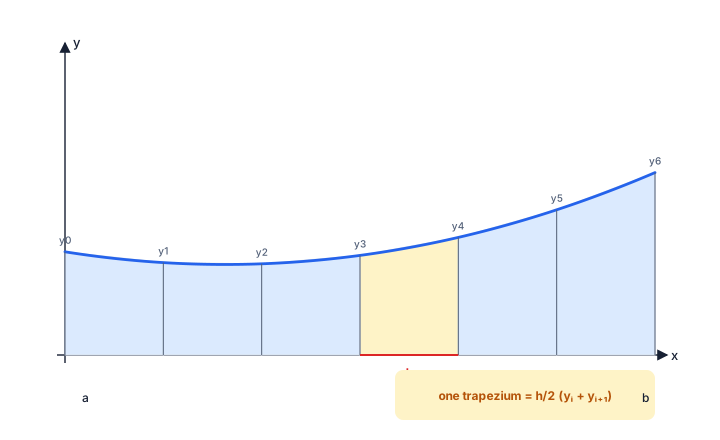
The trapezium rule estimates a definite integral by replacing short pieces of a curve with straight-line chords. The interval from to is divided into strips of equal width
The corresponding -coordinates and ordinates are
for .
The area of one trapezium with parallel vertical sides of lengths and is
Adding all trapezia gives
The interior ordinates are doubled because each is a side of two adjacent trapezia. With trapezia there are ordinates.
Worked example
Use two trapezia to estimate
Here
and the ordinates are
Therefore,
The exact integral is
so the trapezium rule gives an overestimate in this case.
Whether the estimate is too large or too small depends on the shape of the curve.
- If throughout the interval, the curve bends upwards and each chord lies above the curve. The trapezium estimate is greater than the signed integral.
- If throughout the interval, the curve bends downwards and each chord lies below the curve. The trapezium estimate is less than the signed integral.
- If the curvature changes sign, the rule may overestimate on one part and underestimate on another, so no overall conclusion may be possible without further work.
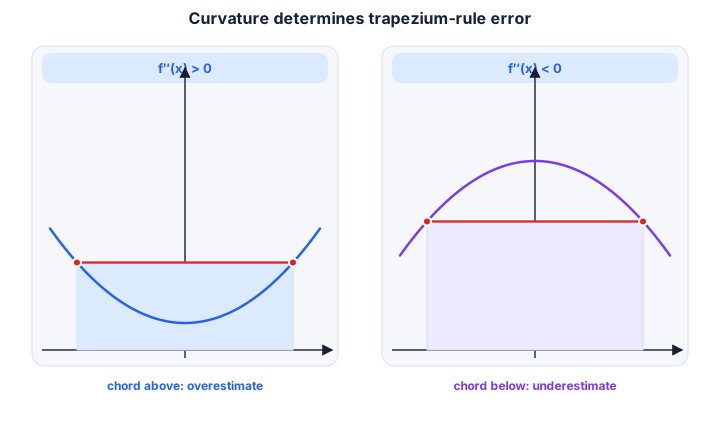
These comparisons are statements about the signed integral. If a curve lies below the -axis and the question asks for positive geometric area, converting the negative integral to a positive area reverses the comparison.
Using more, narrower trapezia usually improves the approximation. In TMUA questions, however, the main challenge is often recognising the structure of the formula or the direction of the error rather than performing lengthy arithmetic.
Common traps
- Use equal-width strips.
- Do not confuse the number of trapezia with the number of ordinates.
- Do not double the first or last ordinate.
- Decide whether the question asks for a signed integral or a positive geometric area.
- Judge overestimate or underestimate from curvature, not merely from whether the function is increasing or decreasing.
Differential Equations of the Form
Differential Equations of the Form
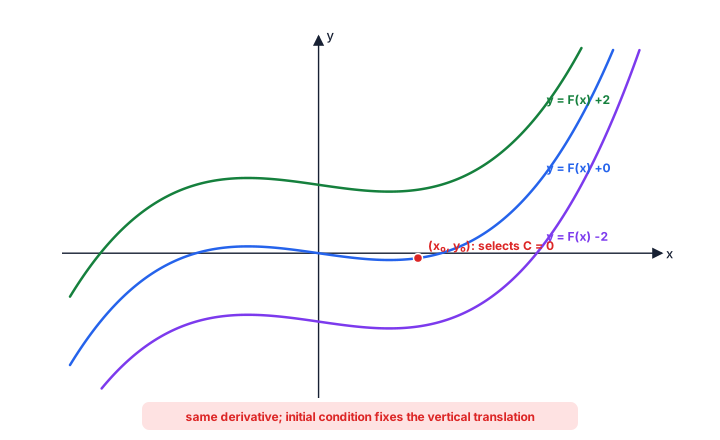
A differential equation of the form
states the gradient of at each value of . Solving it means finding a function whose derivative is .
Integrate with respect to :
The constant represents a family of solution curves that are vertical translations of one another. An additional condition such as when selects one particular curve.
Worked example
Given
and when , find in terms of .
First integrate:
Apply the condition:
so
Therefore,
Check both parts:
and substituting gives .
A useful equivalent form builds the condition into the solution immediately:
Thus, for the example,
This form is often efficient because no separate constant needs to be found.
Common traps and efficient checks
- Do not omit the constant before applying an initial condition.
- Simplify the right-hand side before integrating if it is disguised as a fraction, product or bracketed expression.
- The TMUA scope here is only equations where the derivative is a function of alone; separation of variables is not required.
- Differentiate the final answer and test the given point. These two checks catch most errors quickly.