Overview
Introduction
Introduction
A sequence is an ordered list of terms, which may be finite or infinite. A series is the result of adding terms from a sequence. The word progression is often used as a general label for a sequence or its associated series. The position of a term matters: is the first term, is the second term, and is the term in position .
Sequences Given by an th-Term Formula
Sequences Given by an th-Term Formula
An th-term formula gives a term directly from its position. For example, if
then substituting gives the sequence
The subscript is a label, not multiplication: means the term in position .
An explicit formula can be used in two directions:
- substitute a position to find the corresponding term;
- set the formula equal to a given value and solve for the position.
Worked example
Let
The first three terms are
To determine whether is a term, solve
This gives , so because a term number is a positive integer. Therefore, is the fifth term.
A finite list of terms does not usually determine a unique formula. Many different rules can begin with the same few values, so a claimed pattern must be supported by the rule stated in the question rather than by guesswork alone.
The notation
means
There are terms because both endpoints are included. This inclusive count is a frequent source of errors.
TMUA strategy: Write out two or three terms whenever an indexed expression looks complicated. This often exposes an incorrect starting index, final index or exponent before substantial algebra is done.
Sequences Generated by Recurrence Relations
Sequences Generated by Recurrence Relations
A recurrence relation defines each new term using an earlier term. A simple recurrence has the form
together with an initial value such as . The initial value is essential: without it, the recurrence usually describes many possible sequences.
To generate the sequence, substitute the current term into the rule repeatedly.
Worked example
Suppose
Then
and the values continue as
The sequence alternates with period .
For a recurrence depending only on the immediately preceding term, once a value repeats, all later terms repeat in the same way. In the example, , so applying the same function again must produce , then , and so on.
A value satisfying
is called a fixed value of the recurrence. If some term equals , every subsequent term also equals . For example, if , then is fixed because
You are expected to generate and reason about simple recurrences, but not to solve general recurrence relations by advanced methods.
Common traps
- Do not replace with . The input to is the previous term, not the term number.
- Check the starting index. A rule beginning with produces different labels from one beginning with .
- Do not claim a cycle merely because the first few terms look repetitive. For a one-step recurrence, a cycle is guaranteed once an earlier value actually reappears.
Arithmetic Sequences and Series
Arithmetic Sequences and Series
An arithmetic sequence changes by a constant amount each time. This constant is the common difference :
If the first term is , then moving from the first term to the th term requires steps. Therefore,
The is important: the first term has had no common differences added.
For the sum of the first terms, write the sum forwards and backwards:
Adding corresponding terms gives identical pairs, each equal to . Hence
so
If the last term is , this can be written more simply as
This says that the sum is
The natural numbers form an arithmetic sequence with , and last term . Therefore,
Worked example
An arithmetic sequence begins
Here and . Its 25th term is
The sum of its first 25 terms is
For a consecutive block from the th term to the th term, the number of terms is . You may either treat the block as a new arithmetic sequence or subtract partial sums:
Efficient TMUA methods
- When the first and last terms are easy to identify, use rather than calculating unnecessarily.
- To test whether a sequence is arithmetic, compare consecutive differences rather than relying on appearance.
- If the question asks only for a sum, look for symmetry: terms equally far from the ends have the same total.
Common mistakes
- Using instead of .
- Confusing the th term with the sum .
- Counting the terms from position to position as instead of .
Finite Geometric Series
Finite Geometric Series
A geometric sequence is formed by multiplying by a constant common ratio :
whenever the ratio is defined. If the first term is , then
The sum of the first terms is
Multiplying by gives
Subtracting the second equation from the first causes the middle terms to cancel:
Therefore, for ,
The equivalent form
is sometimes more convenient when . If , every term equals , so
Worked example
Find the sum of the first eight terms of
Here , and . Thus
For the block
the first term is , the common ratio is , and the number of terms is . Hence
It can also be viewed as a difference of partial sums, but the indices must be handled carefully:
where .
Common traps
- The common ratio may be negative, producing alternating signs.
- In , the first term corresponds to exponent .
- Do not use the finite-sum formula with because it would divide by zero.
- Check whether the formula uses over or over ; mixing the two forms changes the sign.
Infinite Geometric Series
Infinite Geometric Series
An infinite series is interpreted through its partial sums. If is the sum of the first terms and the values of approach a fixed number as increases, the series converges to that number. A necessary first check is that the individual terms approach . For a geometric series,
this happens precisely when
Under this condition, as . Starting from
we obtain
The condition is on the magnitude of , not merely on whether . For example, converges, but does not.
If and , the geometric series does not converge:
- gives repeated non-zero terms;
- makes the partial sums oscillate;
- makes the term magnitudes grow;
- for other boundary cases, the terms fail to approach zero.
Worked example
Consider
The first term is and the common ratio is . Since
the series converges and
The sum from the th term onwards is itself an infinite geometric series whose first term is . Therefore,
when .
TMUA strategy: Before using an infinite-sum formula, state or check . This takes little time and prevents one of the most common errors in this topic.
Do not confuse the terms of a sequence with the partial sums of its series. In a convergent geometric series, the individual terms approach , while the partial sums approach .
Factorials and Binomial Coefficients
Factorials and Binomial Coefficients
For a non-negative integer , factorial notation is defined by
with
For example,
The binomial coefficient
counts the number of ways to choose objects from objects when order does not matter. For integers satisfying ,
For example,
Cancelling before evaluating the factorials is usually faster and reduces arithmetic errors.
The coefficients have useful symmetry:
Choosing the objects to keep is equivalent to choosing the objects to leave out. In particular,
Pascal's triangle arranges the binomial coefficients so that each interior entry is the sum of the two entries above it. This gives
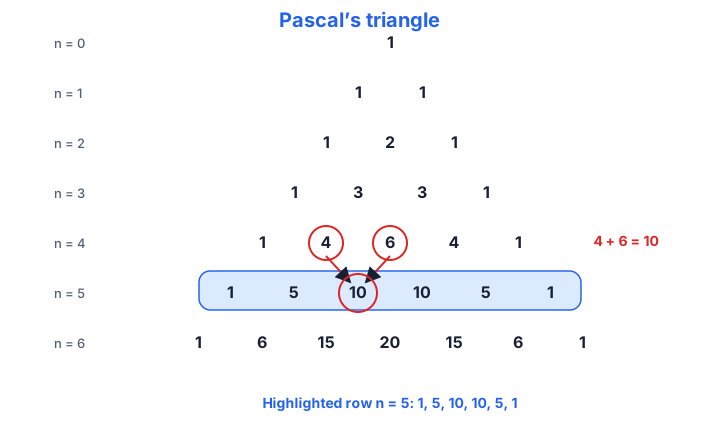
Pascal's triangle is efficient for small powers. For a large power or a question asking for only one term, the factorial formula is usually quicker.
Binomial Expansion
Binomial Expansion
For a positive integer , the binomial theorem expands a power of two terms:
Written out,
For , this becomes
The general term is especially useful. The term involving is
It is called the th term because gives the first term.
For an expression of the form ,
Keep the whole of in brackets before raising it to a power. This preserves constants and signs correctly.
Worked example: finding a coefficient
Find the coefficient of in
The term occurs when :
Therefore, the coefficient is
The sign is positive because the negative term is raised to an even power.
Worked example: finding a constant term
Find the constant term in
The general term is
Its power of is
A constant term has power , so
which gives . The constant term is therefore
Efficient TMUA methods
- When asked for one term or coefficient, use the general term instead of expanding everything.
- Determine the required value of from the power of before doing numerical arithmetic.
- Use when it makes the calculation smaller.
- For consecutive terms, update systematically: the power of the first binomial part decreases by , while the power of the second increases by .
Common mistakes
- Forgetting that in , the minus sign and the are both raised to the power .
- Giving an entire term when the question asks only for its coefficient.
- Confusing the index with the term number: gives the fifth term.
- Using the positive-integer binomial expansion when the power is negative or fractional. Such expansions are not part of this topic.
- Assuming every requested power of must occur. If the equation for has no integer solution with , that power is absent and its coefficient is .